Cleanouts
An Estate Cleanout Checklist That Respects the Family
Clearing a family home is not a logistics problem with feelings attached. It is an emotional process with logistics attached.
Before anything leaves the house
The most important rule of an estate cleanout is that nothing leaves the property until the legal side is settled. If the estate is in probate, or if there is any disagreement among heirs, talk to the attorney before the container arrives rather than after.
Before you start:
- Confirm who has legal authority to dispose of the contents
- Locate the will, deed, titles, insurance policies and financial records
- Photograph every room before anything moves
- Agree among the family who wants what, in writing if there is any tension
- Check whether anything is specifically bequeathed
- Have anything potentially valuable appraised rather than guessed at
The four-pile method
- Keep. Family members are taking it. Label it with a name.
- Sell or donate. Set a deadline — if it has not gone by then, it moves to disposal.
- Dispose. Into the container, or to the appropriate local route.
- Special handling. Documents to shred, medications, firearms, chemicals, electronics, batteries, and — in this state especially — mattresses and textiles.
Nothing goes into a fifth "decide later" pile, because the decide-later pile grows until it swallows the project.
⚠️ Paperwork specific to this city
Things worth looking for in a Fall River family home that a national checklist would not mention:
- Multi-family deeds and tenancy records. A great many families here own a triple-decker and live in one flat while letting the others. That makes the house both a home and a business, with leases, rent records and tenant deposits attached.
- ⚠️ Lead paint compliance records. Massachusetts takes lead seriously on rental property, and a letter of compliance or a deleading certificate is a genuinely valuable document. Losing it means paying for the inspection again.
- Mill and union pension paperwork. Generations worked in the mills and the trades, and old pension, benefit and union records still produce entitlements.
- Portuguese and Azorean family documents. Property records, citizenship papers, birth and baptism certificates from the islands. These are frequently the only copies in the country and are extremely difficult to replace.
- Naturalisation and immigration papers.
- Burial plot deeds, which turn up loose in drawers remarkably often.
- Insurance policies on the building, particularly older multi-family cover.
None of it looks important in a drawer. All of it is worth checking before a box goes in a container.
Things people throw away and regret
- Paperwork not checked. Savings bonds, share certificates, policies, deeds and cash turn up inside books, tins and drawers with genuine regularity.
- Photographs, slides and negatives. Once gone, gone.
- Military records. Discharge papers, medals and service records matter to somebody, always.
- Tools. Hand tools and workshop equipment are collected seriously, and a well-kept mid-century workbench often holds decades of quality.
- Textile and mill memorabilia. Pattern books, shuttles, bobbins, company signage and photographs have a real local market and real historical value in this city.
- Religious items and family linens. Often handmade, often brought over, and routinely bagged for the charity shop without anyone asking.
- Letters in Portuguese that nobody in the current generation reads. Have someone look before they go.
The five-minute rule. Before any container of paper, any book, any tin and any item of furniture goes in the dumpster, someone opens it and looks. It slows the job down and it is worth it every single time.
⚠️ What the waste bans require
An estate clearance produces more banned material than almost any other job, and this is where people get caught.
- ⚠️ Mattresses and box springs — banned since November 2022. A long-occupied family home often has three or four.
- ⚠️ Textiles — banned since November 2022. Decades of clothing, bedding, towels and linen, and worn-out counts.
- Metal — radiators, bed frames, tools, appliances. Banned, and worth money.
- White goods, batteries, cathode ray tubes — and an old house usually has a television nobody has switched on in fifteen years.
- Whole tires, often in the basement or garage.
⭐ The exceptions are worth knowing here more than anywhere. A mattress contaminated with mold, bodily fluids or insects falls outside the ban and can go as ordinary waste — and after a long vacancy that is frequently the case. Futon mattresses, sofa beds, mattress pads and toppers are not covered at all. The detail is here.
And never in a container at all: paint, solvents, fuel, garden chemicals, propane cylinders, medications, firearms and ammunition, refrigerant appliances that have not been evacuated, and ⚠️ asbestos.
⭐ Start with the basement and attic
Local advice that differs from the last few markets this chain has served.
Basements are entirely normal here, and in a house of this age they are where everything ended up. So are the attics. Start there, and in this order:
- Chemicals, fuel and unlabelled containers out before anything else moves. Once boxes are stacked in front of a shelf, the shelf gets forgotten.
- ⚠️ Check for a fuel oil tank. Common in older basements here, and its own job entirely.
- Find every refrigerant appliance. The kitchen fridge is obvious; the chest freezer in the basement is the one that gets missed.
- ⚠️ Look at pipe lagging, boiler insulation and floor tile before anyone touches them. In a pre-1980 building they may contain asbestos, and a clear-out is exactly when they get torn out without a second thought.
- Pull the metal. Banned from disposal, and worth money.
- Set the mattresses and textiles aside rather than loading them.
- Then start on the volume.
Where the local routes fit
- The green cart — ordinary household volume only. A clear-out is not that.
- ⭐ The city's bulky program — $12.00 for one to three items, dropped at the City Garage, 10 Lewiston Street, or collected curbside with the paid sticker attached. It takes furniture, mattresses, box springs, appliances and carpeting rolled and tied. For a handful of items this is by far the cheapest route.
- ⚠️ But it will not take construction debris, and if the clearance turns into a renovation that is a container job.
- Scrap metal — its own route, and it pays.
- The container for everything else, which on an estate clearance is usually most of it.
- ⚠️ Outside the city limits, the bulky program does not apply at all — every surrounding town runs its own arrangements, and three of our communities are in Rhode Island entirely.
Sizing, access, and coming from out of town
- Small apartment or one flat of a triple-decker: 15 yard
- Two to three bedroom house, basement not included: 20 yard
- House with basement and attic: 30 yard, or a 20 with a swap
- Whole triple-decker, all three flats: phased 20 yards rather than one 30
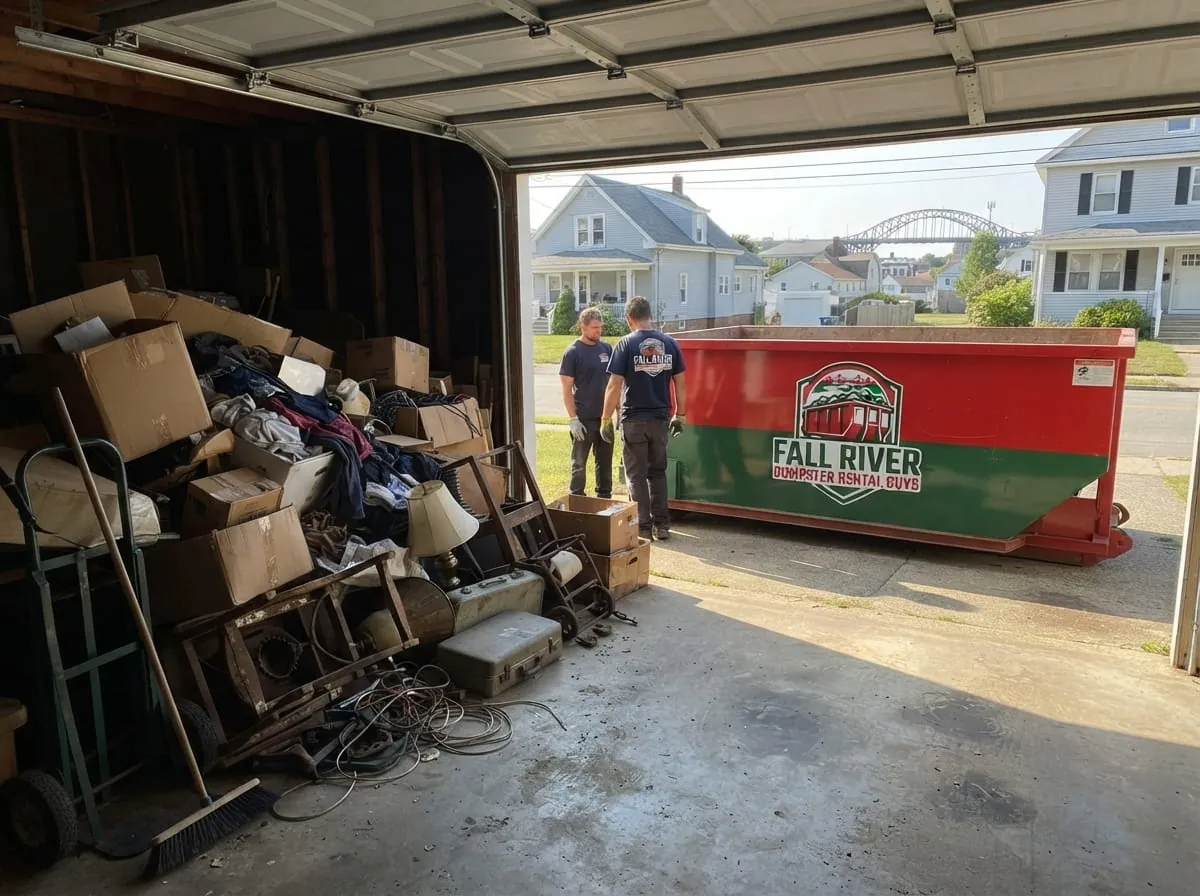
- Long-held family home, everything going: 30 yard, and plan for a second
- ⚠️ No off-street space: 15 yard, or a street placement arranged in advance
Household contents are bulky and light, so these jobs generally size up — unless the street decides otherwise, which here it often does. We schedule estate work with longer rental windows as standard.
A common situation here: families stay in this city for generations, but the children often do not. If you are travelling in to clear a parent's house in a single week, tell us the dates when you book. We will have the container there the day you arrive rather than three days into a week you cannot extend, and we will schedule the swap before you need it.
Four practical notes for a compressed visit: book before you travel; tell us the street, because access here decides the size; deal with the chemicals and the mattresses on day one while you still have help; and check whether the house is a multi-family, because if it was let, there is paperwork you need before anything is cleared.
Need a container in Fall River?
Call and describe the job. Three minutes on the phone gets you a size recommendation, a flat rate and a delivery window — and we will tell you if a smaller, cheaper container is the right answer.
Call (774) 504-5603