Renovation
Old Buildings, Old Materials: Renovating Here
The building stock here is magnificent and it is old. Both of those facts turn up in the container, and one of them turns up in the lab report.
What this city is built of
Fall River was built fast, in granite and timber, by people who expected it to last. A great deal of it has.
Two building types dominate, and they behave completely differently in a renovation:
- The mills. Enormous granite blocks with heavy timber framing, built for machinery rather than people, now holding everything from storage to apartments to small manufacturing.
- The triple-decker. Three stacked flats in a timber frame, built in huge numbers for mill workers, packed shoulder to shoulder up and down the hills with very little space between them.
Both are predominantly pre-war, and a great deal of the housing is pre-1900. That age is why the city looks the way it does, and it is also why a renovation here has two questions attached that a newer building does not.
⚠️ Lead paint: assume it
Any building painted before 1978 should be treated as having lead paint until testing says otherwise. In this city that is most of the housing stock.
What matters for the container:
- Intact painted surfaces — trim, doors, sashes, siding — are generally handled as ordinary construction debris, and plenty of it goes in a container normally.
- The dust and the scrapings are the hazard, not the timber. Containing them is a site practice question rather than a disposal one.
- Massachusetts has serious lead law, particularly for rental property and for homes where children under six live. If you are a landlord, settle this before you start, not after.
- Deleading work has its own rules and licensed people to do it.
We are not a deleading contractor and will not pretend to advise on compliance. What we will do is tell you plainly that in a city of pre-1900 triple-deckers this needs answering before the first wall comes down.
⚠️ Asbestos: the pre-1980 list
Asbestos never goes in a container. Not a small amount, not wrapped, not at the bottom under something else. It needs a licensed abatement contractor.
In a building of this age, look for it in:
- Pipe and boiler lagging — the classic one, and these buildings have substantial old heating systems
- Floor tile and the mastic under it, particularly nine-inch tile
- Sheet flooring and its backing
- Textured ceiling and wall coatings
- Cement siding and shingle
- Window glazing compound and some older roofing products
- Duct insulation and furnace cement
Test first. A test is cheap compared with a failed load, a stop-work order, or the health consequences.
Why the debris weighs so much
Old construction is dense, and people size containers by looking at a room rather than by thinking about material.
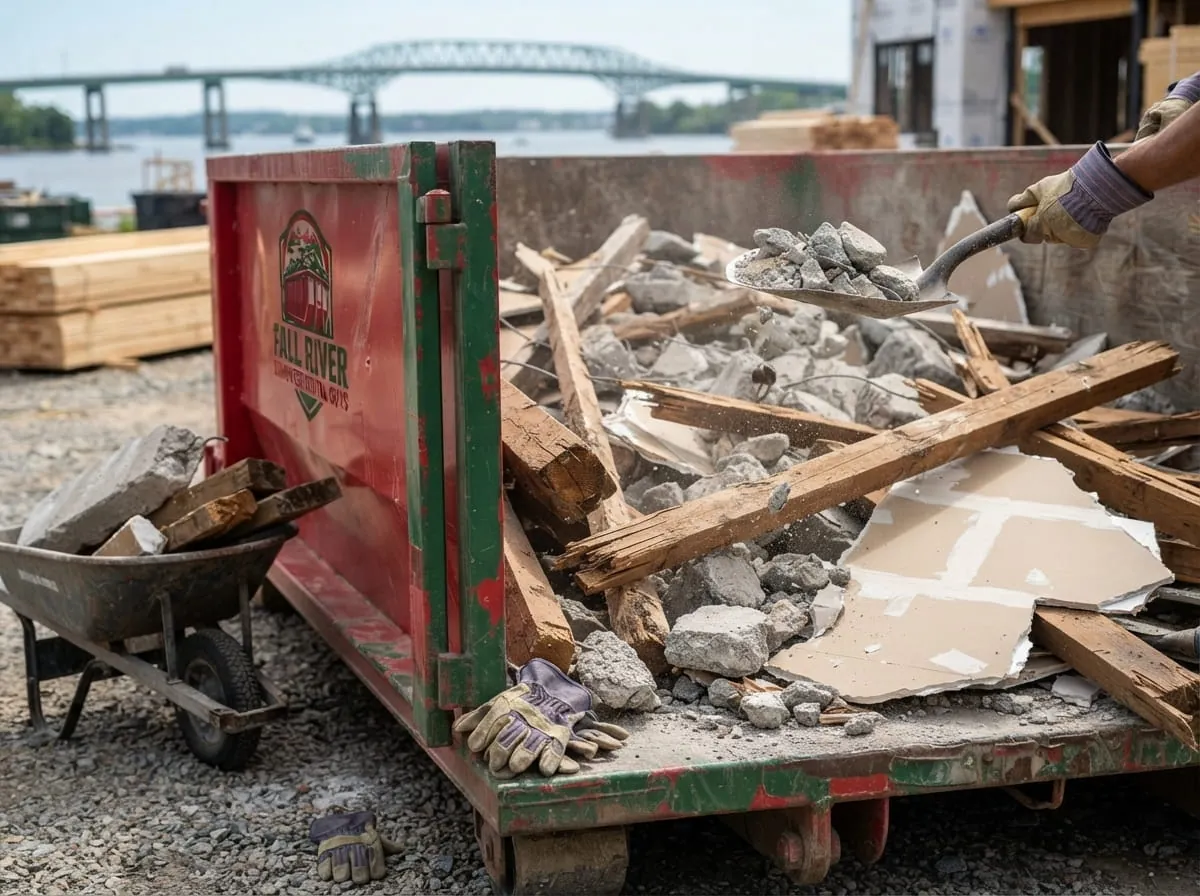
- Plaster and lath is far heavier than drywall. This is the single biggest surprise in an old house here. A room stripped to the studs produces several times the weight the same room would in a modern build.
- Dimensional old-growth timber is dense and often oversized compared with modern lumber.
- Granite and masonry are about as heavy as material gets — steps, foundations, sills, chimney brick.
- Cast iron radiators, soil pipe and bath tubs. All heavy, all metal, and metal is banned from disposal — so it has to come out anyway, and it is worth money when it does.
- Multiple floor layers. Old houses here commonly have three or four generations of flooring stacked on top of each other.
The practical consequence: size down and plan a swap. A 15 yard that gets swapped beats a 30 yard that cannot legally be lifted.
⚠️ The access problem nobody warns you about
This is where Fall River differs from almost every market a generic guide is written for.
The triple-decker streets were laid out before cars. What that means in practice:
- Very little off-street parking, and what exists is often a single tandem space
- Narrow streets, many of them one-way, with parked cars on both sides
- Steep grades. The city climbs hard from the waterfront, and a loaded container on a slope is a genuine consideration rather than a theoretical one
- Short setbacks — the house is close to the sidewalk
- Overhead wires, which matter because a roll-off truck lifts high to tip
What helps: tell us the street, not just the address, and tell us honestly whether there is anywhere off-street. A 15 yard places where a 20 will not, and on some streets the answer is a street placement with permission arranged first. We have written about placement separately.
Mill buildings specifically
A different scale of problem, and worth its own notes.
- The volume is always underestimated. These spaces are deeper and taller than they read, and units have usually been accumulating for decades.
- Heavy timber is dense and often enormous. Cut it down before loading.
- Industrial leftovers — old machinery, shafting, fixings, electrical gear. Most of it is metal, which is banned from disposal and worth separating for both reasons.
- Loading access varies wildly. Some mill units have a dock; some have a goods lift and a staircase. Establish which before you book.
- Asbestos risk is higher, not lower — large old heating systems mean a lot of lagging.
- Phase it. A mill clearance is rarely one container; it is a sequence, and planning the swaps beats discovering you need them.
Sizing an old-building job
- One room stripped to the studs, plaster and lath: 10–15 yard, weight-bound
- Full triple-decker flat renovation: 20 yard with a swap
- Kitchen or bathroom in an older building: 15 yard — cabinetry is bulky, tile and cast iron are dense
- Whole triple-decker gutted: phased 20 yards, not one 30
- Granite steps, foundation or chimney: 10 yard part filled, kept clean
- Mill unit clearance: 30 yard with swaps
- Restaurant or retail strip-out: 30 yard, metal separated
- Anything with multiple floor layers: size down, swap more
Order of work
- Test for asbestos before any demolition in a pre-1980 building
- Settle the lead question, especially on rental property
- Pull the metal — banned from disposal, and worth money
- Separate clean masonry — its own route, and the heaviest thing you have
- Mattresses and textiles out if you are clearing a tenancy as well as renovating
- Work out the access honestly and tell us the street
- Book the container, now that you know what is going in it
- Load heavy and flat first, and stop at the fill line
- Call for the swap before it is full, not after
Need a container in Fall River?
Call and describe the job. Three minutes on the phone gets you a size recommendation, a flat rate and a delivery window — and we will tell you if a smaller, cheaper container is the right answer.
Call (774) 504-5603